Fishin' Frenzy, explained the way a support desk would explain it
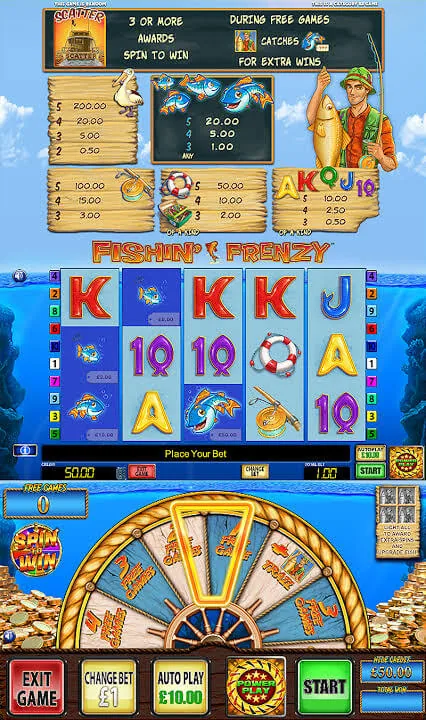
The awkward part first. Fishin' Frenzy is sold to you as a cheerful fishing trip, and what tends to get buried is that the charming bit — the free spins with the fisherman — is the rare bit, while the long stretches in between are where most of a session's money quietly goes. None of that is a fault in the game. It is simply the shape of it, and it is the thing support desks end up explaining most often.
So this page is built around the questions that genuinely arrive in live chat: why the fisherman did not collect, why the same ten lines feel different on a Tuesday night, why a withdrawal is still sitting at pending, and which version of the game someone is even looking at. Answers first, mechanics second.
The round, in the order it actually happens
A round here is short and there is nothing hidden inside it. You pick a stake, the reels spin once, winning combinations are paid from left to right on the ten fixed lines, and anything left on the screen belongs to you until you spin again. The only complication is that the ten lines are always active, so a smaller stake means a smaller amount per line rather than fewer chances to win.
- Set the stake with the plus and minus control, or open the stake menu on mobile. The figure shown is the total for the spin, not the amount per line.
- Spin manually with the round button, or use the smaller button beside it for a set number of automatic spins.
- Winning lines pay immediately and the total is added to your balance before the reels finish settling.
- Scatters pay in any position rather than on a line, and three or more award the free spins.
- Cash out whenever you like. There is no locked balance and no round you have to complete.
The thing people ask about most is the difference between the base game and the feature. In the base game you are chasing line wins and the scatter trigger. In the feature, the paytable changes character entirely, because the money stops coming from lines and starts coming from the fish.
The fisherman is the whole game
Fishin' Frenzy looks like a ten-line slot and is really a collection game wearing a slot's clothes. Most symbols carry ordinary line values. The fish carry cash amounts instead — a specific figure stamped on each one. On his own, the fisherman works as a wild and substitutes for other symbols to complete lines. During the free spins he does something else: when he lands in view, he scoops up the cash values printed on the fish around him.
- The collecting happens inside the free spins, not in the base game. That single fact answers most of the confused messages about the feature not working.
- The amounts add up across the feature rather than multiplying a single line win, so the growth is a running total, not a rising multiplier ladder.
- A fisherman who lands with no fish beside him collects nothing — which looks like a fault and is not one.
- How the total is settled at the end of the feature depends on the build. The paytable in front of you is the authority, not a review written about a different version.
RTP and volatility without the gloss
Return to player is a long-run average taken over an enormous number of spins, and volatility describes how the payouts are distributed around that average. Neither one is a promise about your evening. The figure that counts is the one inside the game's own information panel, because Fishin' Frenzy exists in several builds and reskins, and a percentage quoted on a review page tells you nothing about the copy in front of you.
| What you read | What it means | What it does not mean |
|---|---|---|
| Published RTP | a long-run average across millions of spins on that exact build | that a session returns a fixed share of your stake |
| High volatility | long dry spells punctuated by rarer, larger payouts | that a dry spell is owed an ending |
| Maximum win figure | a cap written into that build's paytable | that it is reachable on an ordinary evening |
| Hit frequency | how often something pays at all, however small | that frequent small wins cover the stake |
Practically, this is a game that will spend a lot of spins doing very little and then do a great deal at once, usually inside the feature. People who enjoy it tend to be comfortable with that rhythm. People who want a steady trickle of small returns are usually happier elsewhere, and there is no shame in working that out after twenty minutes rather than after two hundred.
Stakes, the £5.00 ceiling, and the £2.00 rule for younger players
The cap is a ceiling, not a suggested stake. Most regulars play well below it, and the £2.00 limit for younger players is a legal requirement rather than a setting you can talk your way around. Affordability checks begin at £150.00 of net deposits in a month and use credit-reference data at the first stage, so a request for documents is not an accusation — it is a standard step triggered by a figure.
Auto spins, manual spins, and knowing when to stop
Auto play exists so you do not have to press a button two hundred times, and it is also the fastest way to lose track of what you have spent. Most UKGC-licensed sites now cap the number of automatic spins, stop the sequence when a feature triggers, and show a running total. Use the number, not the feeling.
- Manual spinning keeps you aware of the balance. It is slower and that is the point.
- Auto play is better suited to a fixed, small number of spins than to an open-ended session.
- Set the deposit limit before you spin, not after a bad run. Limits set in the moment are usually set badly.
- Decide what a session is worth to you beforehand and treat that figure as spent.
How it holds up on a phone
This is a light game and it runs comfortably in a mobile browser, which is how most people play it. The layout stacks the reels vertically, keeps the stake control reachable with a thumb, and moves the paytable behind an information button. Nothing essential is lost.
- Portrait is the natural orientation. Landscape works, but the paytable becomes fiddly.
- The fish values are small on a phone screen. Tap the information button for the symbol values rather than squinting at the reels.
- Genuine apps are available from both major stores for licensed UK operators, but the browser version is usually identical and avoids another login.
- On a weak connection the reels can stutter. That is the connection, not the game, and the result is already decided by the time the animation starts.
Demo play, real money, and telling them apart
Free play is common on licensed UK sites, but on many of them it is only shown to logged-in, age-verified accounts rather than to anyone who lands on the page. That is a deliberate choice and a reasonable one. Real-money play is legal here with a UKGC-licensed operator, and unlicensed sites are illegal to market to British players, so the check matters more than the marketing copy.
- Look for the UKGC licence number in the footer and match it against the public register. A logo alone proves nothing.
- A real-money account has a balance in pounds, a cash-out button and a verified identity behind it.
- Demo play has no balance to withdraw and no chance of a return. It is there to show you the mechanics, and it does that well.
- If you ever need to stop, one GAMSTOP registration blocks every licensed site in the country for between six months and five years. Play here is 18+ and nothing on this page is a reason to skip that.
| What you are looking at | How to tell | |
|---|---|---|
| Real-money play | you are logged in, identity verified, and the balance reads in pounds | → |
| Demo play | no balance, no cash-out, often only visible to verified accounts | → |
| An unlicensed copy | no licence number in the footer, no stake cap, no mention of GAMSTOP | → |
One last honest note on withdrawals. The first one is always the slowest, because document checks come before the money moves. After that, e-wallets usually clear in a few hours to a day, Faster Payments to a bank account land the same day or within two working days, and debit card refunds take one to three working days. If yours is slower than that, the delay is almost always a pending document rather than the game.
FAQ
Why did the fisherman land on a fish and collect nothing?
Because collecting only happens during the free spins. In the base game the fisherman is a plain wild and substitutes for other symbols; he does not scoop up fish values until the feature is running. If it happens inside the feature and the total clearly did not move, capture the whole screen including the balance and round history and send it to support.
Can I play Fishin' Frenzy for free in the UK?
Usually yes, but on many licensed sites the demo is only offered to logged-in, age-verified accounts rather than to anyone visiting the page. The demo uses the same mechanics and the same maths as the paid version, so it is a fair way to learn the feature before staking anything.
Why is my withdrawal still pending after two days?
The first withdrawal is always the slowest, because age and identity checks plus document review normally take 24 to 48 hours and happen before the payment is released. Once that is done, e-wallets clear in a few hours to a day, Faster Payments land the same day or within two working days, and debit card refunds take one to three working days.
Is there a best time of day, or a pattern in the reels?
No. The random number generator has no memory of previous spins, so results are independent of the time, your balance and how long you have played. Anything sold as a timing trick or a pattern is either a misunderstanding or a scam, and neither changes the outcome of a spin.
Which version am I playing, and does the RTP differ between sites?
Fishin' Frenzy exists in several builds, and the return figure is written into each one. Two sites can therefore show different numbers for what looks like the same game. Open the game's information panel and read the RTP published there — that figure governs the copy you are actually playing, whatever a review page says.